Author Jason Rosenthal Taps Into Our Collective Grief By Sharing Memories of His Late Wife
Below are excerpts from “My Wife Said You May Want to Marry Me” selected for The Sunday Paper by author Jason Rosenthal
“What this book is … is an exploration of what it means to love, to lose, and to emerge from that loss somehow ready to be resilient in surprising and unexpected ways. It is a story of love and loss but also of appreciating the joy, beauty, and vitality of life. A story of how you come to the end of one part of your life and find a way to turn the page to the next. A story of my life with an exceptional woman, my wife, Amy Krouse Rosenthal. And a story of life without her as well.
Amy was an author, speaker, and filmmaker. As an author of two groundbreaking memoirs and as a children’s book author, she has touched thousands of minds, both young and old, but the piece of writing she is best known for is an essay that appeared in the Modern Love column of the New York Times. It’s called “You May Want to Marry My Husband,” and it was published on March 3, 2017.
Ten days later, Amy died.
She was too ill to appreciate the response, but it was spectacular. Her essay immediately went viral and was ultimately read by more than five million people. The genuineness of her voice leapt off the page to all who encountered it. The article was many things, but most of all it was a message to me. In retrospect, I now think that Amy, who after all knew me better than any human on this planet after twenty-six years of marriage and building a family and life together, perhaps thought that I needed her to express permission to find love after she died.
It’s a difficult thing for a dying spouse to say to her partner, let alone share with the entire world. And yet, like so much that Amy did, she pulled it off in a seemingly effortless manner.
The ten days between the date the essay was published and the day Amy died seemed like a microcosm of everything life has to offer—what should have been her highest high was tragically overshadowed by her imminent death. That impossible set of circumstances sent me on a journey I never imagined, didn’t want, and couldn’t have predicted; in one way it had an ending that came too soon. In another, it is an adventure that I will be on for the rest of my life. An odyssey that was made possible because of Amy.
—
What follows in these pages is my attempt to share whatever small pieces of wisdom I’ve gained from an otherwise devastating process. Amy was a lot of things, but perhaps above all else, she was an optimist, her hunger for life insatiable. Her way of looking at the world was inspiring, even during difficult moments, and she would have delighted in the idea that some part of our story together could help someone else through their own personal darkness.
Not all love stories end the way you want them to, but often, that’s what makes them worth telling.
….
Some combination of Amy’s New York Times essay, my TED talk, and public speaking inspired people from all over the world to write to me, wanting to connect about end-of-life issues, finding new meaning after loss, and ways to reclaim the joy, hope, and passion their loss seemed to have taken away.
There have been many, many letters, some of them in cursive longhand, and it deeply touches me that people in pain are moved to reach out to me, a total stranger, not just to tell their stories but to essentially say, “I’m sorry for your loss, and I understand, because I’ve been through it, too.” I’ve said it before, but it bears repeating—people are good.
As I began to get more requests for speaking engagements, I had to dig deep to make certain that I was committed to speaking about grief and loss while staying resilient at the same time. The power of the letters, emails, and packages I received made it clear that the work I was setting out to do was by far the most meaningful I had ever done. Having these incredible connections all over the world, even with total strangers, confirmed for me that I needed to keep talking openly about love, loss, and filling one’s empty space.
These letters are also a clear reminder that loss is loss is loss. The death of a spouse, either suddenly or after a slow, painful illness. The death of a family pet. Losing a job after years of hard work. A medical condition that leads to a life-changing disability. Hitting rock bottom because of finances, or an addiction, or a mental disorder. Having to place a family member in memory care. Simply losing a dream. They all hurt. They all matter. And they connect us all when we reach out like Amy did, like these people did, and reassure us that, even if it’s a stranger on the other side of the world, someone cares.
Grief and loss are a shared tale.
—
I have come to a place where I have a deeper appreciation for what I had with Amy. I have made peace with the reminders I see about Amy. I have the realization now that I am one of the fortunate ones to have loved so deeply and to have experienced grief in such a profound way. It means to me that I was one of the lucky ones, to have cared and loved so much—why else would I have such intense reactions to my loss?
So I do not mind reminders of my past. In fact, I want more. When I go back to “You May Want to Marry My Husband,” I now realize that Amy must have known what would happen to me if her piece was published in the Modern Love column. It meant that I would be the center of some significant attention.
She knew me better than any human being ever has, so maybe more of Amy means more is also where I am going.”
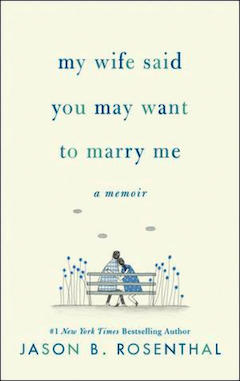
From the book MY WIFE SAID YOU MAY WANT TO MARRY ME: A Memoir by Jason Rosenthal. Copyright © 2020 by Jason Rosenthal. To be published on April 21, 2020 by Harper, an imprint of HarperCollins Publishers. Reprinted by permission.
This excerpt was featured in the April 26th edition of The Sunday Paper. The Sunday Paper inspires hearts and minds to rise above the noise. To get The Sunday Paper delivered to your inbox each Sunday morning for free, click here to subscribe.