Journalist Frank Bruni Woke Up One Day Partially Blind. Here’s How His Experience Gave Him an Entirely New Outlook on Life
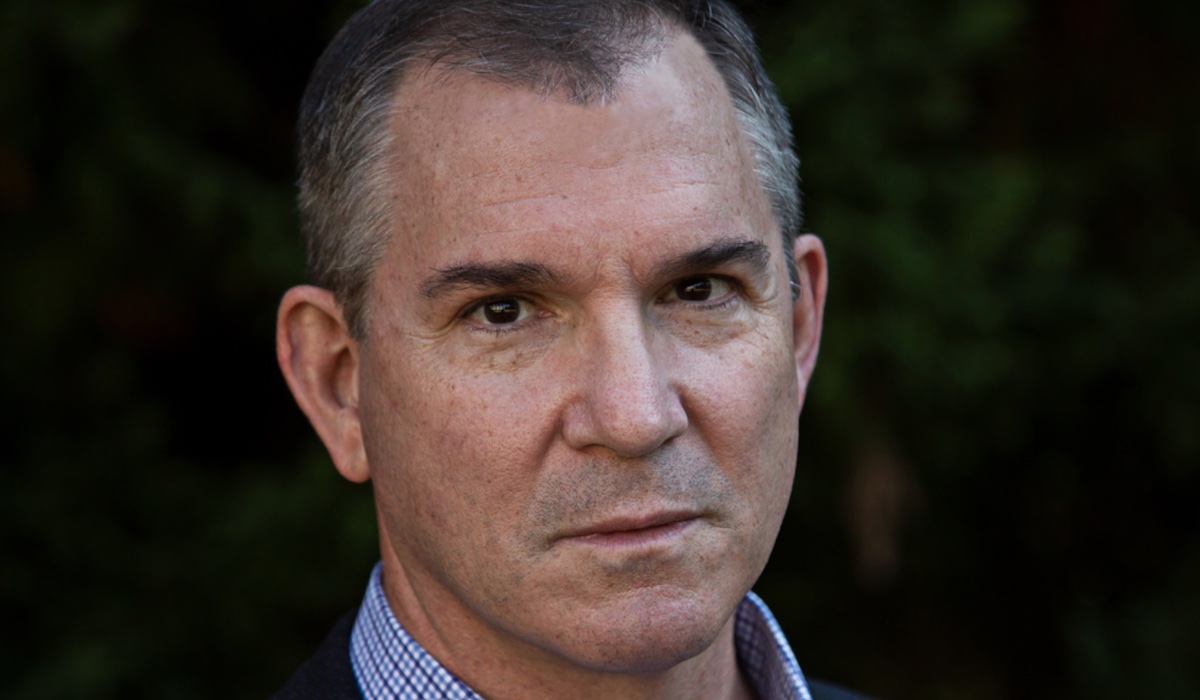
In 2017, Frank Bruni woke up and couldn’t see out of his right eye. He had suffered a stroke that severely damaged his optic nerve causing a vision disorder. There was a good chance he could go blind in his left eye, doctors told him.
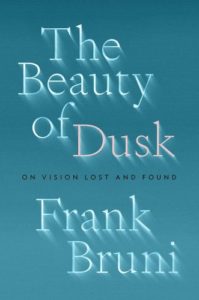
What ensued for Bruni, a journalist and writer, was a long series of doctor visits, two experimental clinical trials, loss, and struggles. He writes about it all in his new memoir, The Beauty of Dusk, with the same precise clarity and melodic wit he layers in his New York Times op-eds.
But what is remarkable is not only the fact that he persevered but rather the empathy and curiosity with which he faced his hardships. Bruni visited with people who had suffered severe loss in their lives, interviewing them and weaving together their stories to make a narrative quilt of learnings and found light. “I was able, in a very fortunate and privileged way because I’m a journalist and a writer, to investigate my own situation and mine it for insights, for bits of life wisdom, for advice,” he tells me by phone.
The result is a book that transcends memoir. Bruni’s sharing creates a beacon, reminding us that often in life’s cruelties there can be the opportunity to stretch beyond our measure.
A Conversation with Frank Bruni
As a longtime writer and journalist, you’ve been a student in your career. You ask questions. You research. How did that vantage point help you as you were navigating your vision loss?
We all have certain habits and tools that we use to navigate the world. We all have certain dynamics at our disposal or not. I think when something very challenging happens to you and you confront a set of life circumstances that aren’t ideal and have the potential to really knock you down and throw you off your stride, one important thing to do is to say, okay, as I’m navigating this, what are my strengths? What tools do I have available to me? What are my weapons in life? And how can those be used in this situation to either minimize the damage and sadness or to find some sort of upside.
In my case, I report, I write, so is there an opportunity here to report and write that could have meaning both for me and for readers. As soon as I asked that question, I realized that my vision disorder was rare. My basic predicament was far from rare. It was representative. It was universal. Every single one of us at some point in our lives, certainly when we get older, is going to encounter some physical setbacks that are going to force us to make adjustments and adaptations in our lives. And I thought if I look at what I’m experiencing through that lens, if I report it and write about it through that lens, I can do something here that is much bigger than me.
I want to talk about complacency and about taking things for granted. You write that we so often push the meaningful things in life to tomorrow’s schedule, to next week’s schedule, to next month’s schedule. How can we better pay attention to the things that matter?
There’s a word that has become so used and thus so overused in recent years, that I worry it doesn’t have much meaning anymore. And it’s not the word that was in my mind as I did all of this, but it is mindfulness. It’s as simple and as complicated as pausing and saying to yourself: What do I really appreciate about my day? What are the things that really bring me peace and pleasure that are within my control? And why am I not focusing on those? Because there’s bounty there. And why, in God’s name, am I not relishing those?
It’s about flicking a switch in your mind. You have to flick it a couple of times, over and over again before, before you do it more automatically. I used to live near Central Park. Now I live near the woods in Chapel Hill, North Carolina. Once I kind of woke up in the way I’m talking about, when I’m walking, as I do daily with my dog, and we come upon some deer, I revel in those deer and in how beautiful they are in a way that I never would before. I will notice if the breeze has the perfect cold tickle in it, I will notice the sun’s sparkle off the water in the creek. To me, the mystery is why I didn’t before.
Part of what I’m talking about makes me a cliché. When things have been taken away from you, or when you have been faced with the prospect that they’ll be taken away from you as I have in regards to my vision, you certainly appreciate them as never before. But the craziness of our kind of experience as humans is that it often takes a great threat or setback to flick that switch in your mind and to end up in a place of awareness of what’s around you. To have an appreciation of it and gratitude. I found that came to me in a new way. When I lost part of my eyesight, when I was told I might go blind, when I realized I had a choice, I could either emphasize and dwell on what had been taken from me and what might be taken from me, or I could do the much healthier and more happy-making thing and do a tally of what remained. I appreciate what remains like never before.
You wrote that you took a psychology class in college and the professor told you that life is about adjusting to loss. This comment has stayed with you.
It’s funny. Probably two-thirds of the classes I took in college I might remember the title but nothing about what happened. But in that class, I remember that because at the time I thought “this man is obsessed” because he just kept on saying that in different contexts. It was something that he felt was fundamental. It stuck in my mind the way a lyric from a favorite song will stick in your mind.
I remember thinking “that sounds like a slogan.” But I flashback on it again through the prism of what happened to me and I thought, “he really is right.” Although I would reword it in a different way. I would say life is about accepting the inevitability of loss and realizing that you can frame and talk about loss in a different way. In the beginning, I felt like the parameters of possibility have shrunken. Things I did easily before I’m not going to be able to do well. That initially felt to me like a diminishment, but then I realized, no, I’m just going to do things differently.
Talk more about the parameters of possibility…
There’s as much of a case to be made for the parameters of possibility not shrinking when you encounter a physical threat or setback, but the parameters of possibility changing. I can’t read as quickly as I did before. I can’t write with as few errors, at least in the first draft, as I did before. But take the reading: I switched to two of every three books I consume these days to audiobook form. I could never hold my attention to an audiobook before. I would be rewinding and rewinding, and I had to listen to it at the slowest speed possible. Now I listen to them at 1.7 speed. And I remember as much from an audiobook as I do from a book that I read—and that’s with a 57-year-old brain not with a 25-year-old brain. So I look at that and I think, life isn’t about adjusting to loss, exactly. It’s about seeing that there’s a more complicated calculus than gain and loss.
 You interviewed many people who have gone through immense struggles, and you include their stories in the book. One example is Juan José, a man who is blind. How did his story and that of the others help you reframe how you approached your experience?
The people I talked to, what they’ve been through and what they had to share, helped me immeasurably.
There are people all around us who have struggled. We know it, but we don’t look at it. Or we know it, but we step away from it because we think it’d be uncomfortable to talk about. These people have so, so much wisdom to share with us and we never harvest that wisdom—that’s just insane. After this happened to me, I took a fresh look at people; people whom I’d known for long and people I was just encountering. I tested the waters and thought, are they willing to talk about what they’ve been through? I think you’d find if you did this in your own life, they’re grateful to be acknowledged and to be asked about it. They have extraordinary counsel to give.
Something that I now do is about re-routing your thoughts to what powers and what control you still have versus what power and what control have been taken from you. In Juan José’s case, he developed an interesting perspective on his blindness. It had become for him, and he didn’t use these words, a point of pride for him. He would never say, “I’m glad I’m blind, oh my blindness is no particular challenge.” But it was an unchangeable fact and facet of his life. He had learned to take great pride in how well he had managed it and in how full his life was in defiance of what its limitations were supposed to be. As I listened to him talk about this in his words, I thought to myself that the aphorism ‘when life gives you lemons’ is wrong. It shouldn’t be ‘when life gives you lemons, make lemonade.’ It should be ‘when life gives you lemons, take a bow’ because you’ve gotten those lemons and you are still striving forward, you should be proud of yourself.
I do want to say one thing: I am not minimizing that some people are going through a degree of pain, are experiencing a magnitude of physical difficulty, that there is no way to spin it as positive. And I’m not spinning it as positive, per se. I’m saying a lot of our struggles can benefit enormously and can receive a shift of perspective that brings us to a place that’s much more sustainable than a place of self-pity and sorrow.
Lastly, Frank, there is so much going on in the world. People are on edge. People are suffering tragedy and loss. The horrors in Ukraine continue to unfold. As a journalist and somebody steeped in media, what can we take from this when we’re feeling overwhelmed or helpless?
Through what happened to me, I opened my eyes and became much more aware that struggle and hardship are almost a default setting of life. I became much more aware of some of the bad turns that other people have had to deal with. And in contrast, most of the blessings of my life. I watch what’s going on in Ukraine with horror, with sadness. I also watch it with the sense that it’s important for us to look at what the Ukrainians are going through, to look at how these events and fate came for them in a way that they had no control over. They’re going to have to deal with these events in a way that has completely upended their lives and will probably color their lives forevermore.
It would be folly and it would be perverse for us as human beings not to look at that. If we are fortunate enough to be living in peace, to be living still with a sense of agency over our lives—which we are in this country—it would be folly and just dead wrong for us not to look at that. We would be doing a disservice to the Ukrainians and what they’re going through not to feel enormous gratitude to be in a country whose borders are not threatened and where we have agency. We owe it to all the people in the world, not just in Ukraine but throughout the world who don’t have that peace and that agency. We owe it to them and to ourselves to feel and recognize how blessed we are.
Frank Bruni has been a journalist for more than three decades, including more than twenty-five years at The New York Times, the last ten of them as a nationally renowned op-ed columnist who appeared frequently as a television commentator. He was also a White House correspondent for the Times, its Rome bureau chief and its chief restaurant critic. He is the author of three New York Times bestsellers. In July 2021, he became a professor at Duke University, teaching media-oriented classes in the Sanford School of Public Policy. To learn more visit frankbruni.com.