I Thought There’d Be Coasting

It was the worst of times, it was the worst of times.
My friend Sasha and I are meeting up for an impromptu lunch. Sasha proposed a casual Mediterranean café on the east side of Los Angeles, the kind of place where you order from the counter and a server drops it off at your table. It’s not an expensive eatery, but I’m on my recently instituted austerity budget, so I scarf down a few handfuls of almonds on the ride over and order a small side of pickled radishes. Sasha gets a lamb kebab salad, and had I known she was picking up the check, I would have ordered that too. Drizzled with creamy tahini dressing, it looks and smells delicious. When she invites me to tuck into it, I accept with an amount of enthusiasm that startles both of us. “Thank you,” I gush as though I hadn’t eaten in weeks, which is not true. If anything, I’ve been stress eating; it’s just that lately even small gestures of kindness seem as precious as winning the lottery.
Sasha and I have only been in sporadic touch over the last few eventful years, and as we catch up she tells me that she has just enrolled her family in Medi-Cal, our state-sponsored low-income health insurance plan. I’m stunned. She always seems so . . . so . . . downright jaunty, at least on social media. But no, we’re in similar straits, like ducks, madly paddling just below the surface.
Much of her regular employment has evaporated—her income, like mine, is now subject to the vagaries of the gig economy. Decades of maintaining a manageable if sometime marginal stability have imploded, sending us on a roller coaster of emotional and financial mobility, a decidedly downhill ride.
I explain that I recently lost my coveted union health insurance and am considering following the lead of a friend who’d recently signed up for an absurdly affordable plan, the only catch being that you had to have a preexisting condition. “What is it? I might already have it,” Sasha said, hopeful at the prospect of lowering her overhead even more.
“Accepting Jesus Christ as your savior. Oh, and they don’t cover birth control,” I answer. And that’s when we lose it, dissolving into a fit of laughter because we’re both in menopause and birth control is one of the only things we no longer have to worry about.
After inhaling most of her kebab, I treat us to coffee; we share a cookie and commiserate. We are not living in a war zone; we are not economic or climate refugees. We are so fortunate. As we say goodbye, the last bite of cookie wrapped in a napkin in my purse, we hug, clinging to each other longer than either of us expected. When did things go so horribly wrong?
This is how it started.
In the weeks before my kid flew the coop, I was racing around the house like a maniac.
“You need to know how to boil an egg! Iron a shirt! Make a fire by rubbing two sticks together!”
“Mom, I’m vegan. I’ll be living in a dorm, you don’t know how to start a fire without matches, and nobody irons anymore. We don’t even own an iron.”
From what I’d read, after our tearful college dorm room goodbyes, my future would be filled with hot-air balloon tours and Zumba classes. Motherhood? My work was done. Kid successfully launched, with all that me-time, I could improve the quality of my life, enjoy my blissfully quiet and tidy home. Maybe I’d learn to make soup from scratch; my husband and I would rekindle our waning desire for each other. Not only that, I was excitedly planning on replacing the living room sofa we’d had since before we’d gotten married, twenty years prior.
That love seat had seen a lot of action. It was the first piece of furniture we’d bought together and it was perfect for newlywed canoodling. Then came baby puke, mac and cheese spillage, popcorn grease, and pen marks, followed by teenage hormones. A friend of Ezra’s had camped out on the couch for a week, that last hurrah before heading off to college. Echo had some kind of endocrine disorder, and now I couldn’t get the scent of armpits and old sneakers out of the fabric. After my kid was safely ensconced in their college dorm room, I went furniture shopping at a neighborhood store. It’s the kind of place that sells handmade chocolates and candles with ironically themed scents like “neo-hippie bullshit” and “nonbinary anxiety,” and carries a furniture line named for iconic Californian authors. The James Ellroy: louche, low to the ground, ideal landing spot for the falling down drunk. The Bukowski: a bit hulking, large enough to accommodate a big man or a couple in flagrante. Didion: half the size, more delicately rendered, nothing froufrou about it. I was leaning Bukowski. I had plans for that couch. Sure, my marriage had been so strained we’d been sleeping in separate bedrooms for upward of a year, but in the 1950s, couples spent entire marriages in separate bedrooms.
The state of our union wasn’t perfect. I assumed my husband and I weren’t any more miserable than everyone else who made the same amount of money as we did. I’d see him passed out on the couch, frustrated by the transactional nature of our relationship, and I’d wonder: was it worth it to forgo garlic for dinner (bloating, so unattractive) and persevere in the search for the perfect lube (chafing, so excruciating)? If we could just muddle through these middling years, I calculated that between Social Security and our union pensions, we could look forward to a moderate but reliable income when we turned sixty-five. Provided Social Security remained solvent. Provided our union pension plan didn’t implode. Provided I could keep providing an income, as I was the breadwinner at that point. That was a lot of provideds, but I was counting on them.
I was holding up a selection of swatches when my husband announced that I should pick out the fabric I liked best. He, too, had plans. They just didn’t include me. Instead of a new couch, he wanted a new life.
Then both of my parents died; my kid landed in rehab for drug and alcohol addiction; failing to qualify for my union’s health insurance meant the family premium ballooned, leaving my finances in further disarray; one of my cats disappeared; and my tennis teacher fired me.
Getting booted from my weekly cardio tennis class, at twenty dollars a pop, seemed like a low blow. Sure, I was showing up late, without sneakers, and weeping continuously throughout the lesson, but the six other mothers and I had been playing since our kids were in middle school together, and this was my last connection to that parent community. Despite five years of lessons, I’d dubbed my serve “the matzoh ball,” because although it looks like it’s got substance, it crumbles on impact. I wore my lack of improvement as a badge of honor. I was reliably inept. In a world that was constantly changing, at least I was consistent.
“You need to embrace this next chapter,” my friend Tonya insisted.
So did my accountant.
“Don’t next-chapter me,” I told them. “Next chapter is spin for ‘dreaded challenges you’re about to encounter on your journey’ and should be as suspect as someone telling you ‘having cancer can be a gift.’” I’m fifty-five. Is there anyone who’s thrilled about starting a next chapter at my age? When does the coasting begin? I thought I’d be coasting by now.
Something had to give. Or rather, everything had to give.
It wasn’t a shock to read that the rate of people in my age range filing for bankruptcy is three times what it was in 1991. One-third reported that helping aging parents and children, coupled with rising health-care costs, were contributing factors. Others were bumping up against that gray ceiling in their chosen fields and pursuing new endeavors or going back to school.
There is no upside to downward financial mobility, but there is value in reassessing priorities. Indulging in even a modicum of retail therapy or taking that island vacation to regain your mojo are other midlife rites of passage that have fallen by the wayside. I’d hoped to one day get my kitchen remodeled; instead, I had my vagina reupholstered.
Even friends who’d managed financial solvency were dealing with the emotional stresses of our Gen Z offspring. Our children no longer go off to college and set up shop in some city or town, returning home only for vacations or holidays. No, they come back to the childhood bedrooms they grew up in. My neighbor’s son came home for a gap year that lasted for three. Remember when the phrase “eighteen and out” was a familiar refrain? Pew Research reports that, for the first time in 130 years, a third of young adults in America are living with their parents.
My friend Paula’s story is a cautionary tale. After sending her youngest off to college, she celebrated. Kids launched: check that off the to-do list. She’d downsized from her spacious but pricey two bedroom to a modest one bedroom/one bathroom in Manhattan when she received a notification that her son’s college dorm fee was doubling. He attends school locally, so they converted a walk-in closet in her living room into a bedroom for him. Then her daughter, a recent college grad who was living with her father in California, decided she wanted to give it a go in New York. With her son in a closet and her daughter on her couch, Paula is tithing her income to a Reiki practitioner. As Paula says, “It’s hard to know what to expect. I’m not sure when they’ll ever move out.”
My kid entered college a music major. Every parent knows that’s tantamount to announcing, “My future plans include living in my parents’ basement.”
I also lost a son, but gained a gender nonbinary kid. The summer that Ezra got sober, they began identifying as a grammar-defying queer person, and I began relearning my pronouns one day at a time. To honor their gender expression, I write about my child in these stories using the pronouns they, them, theirs. To remain in the family home in anticipation of my kid’s return, my nest, by necessity, has been monetized. I joined the legions pioneering new iterations of old-world home sharing. Barely a week goes by without an item in the news touting home sharing’s benefits, including preventing loneliness and isolation. Here’s a scene I never pictured for myself in my fifties: wondering if the couple with tattoos, one reading G R I F T E R and the other D R I F T E R, would make for good roomies.
Where we once expected to sprint to the launch of the offspring, midlife parenting is now, more than ever, an endurance sport, a marathon with no finish line in sight. All speculation aside over whether helicopter parenting or snowplow parenting or even combine harvester parenting (OK, I made that one up) is to blame, the net effect is that parents of adult children can find that they are— still—always on call. Along with the expected “send money,” if you are the parent of a child born between 1990 and this morning, I can almost guarantee that you’ll receive this text: “When a piercing gets infected, what should you put on it?” I didn’t even know my child had a piercing. Or five. I’m going to save you the trouble of googling the answer: it’s saline solution.
I wrote the last chapters of my book as people across the globe endured incalculable losses in the wake of COVID-19. In my little corner of the world, Ezra completed their last semester of college online, officially earning a BA in music, although arguably the last months were spent majoring in Rubik’s Cube and minoring in sourdough starter. Their college graduation speaker was supposed to be David Byrne. Instead, as Ezra sheltered in place on campus, I watched a truncated, livestreamed ceremony alone in my backyard. Names silently scrolled by on the tiny screen; even the font was unremarkable.
The need to cultivate adaptability in the face of an unknown future, even more pressing than when I started writing the stories in this collection, made me look to a species that is in many ways our better.
Fifty million years ago, ancient whales, once terrestrial mammals, bid farewell to terra firma and took to the seas. The presence of vestigial limbs can still be seen in modern-day whale flippers. I hope it doesn’t come to that, though I won’t be surprised if one day I wake up and discover that my newly acquired love handles have morphed into fins. I’m still above water, and that feels like a tiny victory.
Oh, and I did get a new couch. I hope it’s well made because it will need to last a long time. I couldn’t afford the Didion, the Bukowski, or the Ellroy, but remember Mary’s best friend on The Mary Tyler Moore Show? Even watching as a kid, I instinctively related to her BFF more than goody-two-shoes, perfectly coiffed Mary. She had career highs and lows, husbands and lovers who came and went, but she survived—even thrived—based on sheer willpower, tenacity, and her unfailing sense of humor. Where Mary could be resistant to change, she rolled with the punches, and while Mary was the straight man (in unfortunate comedy lingo), she got the punch lines. My new couch is kind of the best friend of those superstar sofas.
I call it the Rhoda.
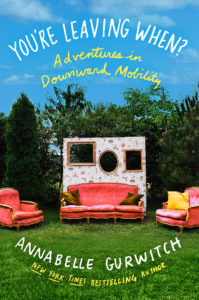
Excerpted from YOU’RE LEAVING WHEN? ADVENTURES IN DOWNWARD MOBILITY by Annabelle Gurwitch. Published with permission of Counterpoint Press. Copyright © 2021 by Annabelle Gurwitch