Noise and the Two Kinds of Error

Imagine that four teams of friends have gone to a shooting arcade. Each team consists of five people; they share one rifle, and each person fires one shot. Figure 1 shows their results.
In an ideal world, every shot would hit the bull’s‑eye.
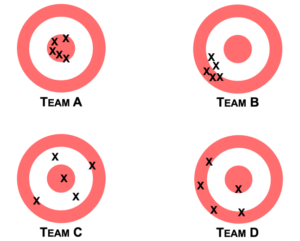
Figure 1: Four teams
That is nearly the case for Team A. The team’s shots are tightly clustered around the bull’s‑eye, close to a perfect pattern.
We call Team B biased because its shots are systematically off target. As the figure illustrates, the consistency of the bias supports a prediction. If one of the team’s members were to take another shot, we would bet on its landing in the same area as the first five. The consistency of the bias also invites a causal explanation: perhaps the gunsight on the team’s rifle was bent.
We call Team C noisy because its shots are widely scattered. There is no obvious bias, because the impacts are roughly centered on the bull’s‑eye. If one of the team’s members took another shot, we would know very little about where it is likely to hit. Furthermore, no interesting hypothesis comes to mind to explain the results of Team C. We know that its members are poor shots. We do not know why they are so noisy.
Team D is both biased and noisy. Like Team B, its shots are systematically off target; like Team C, its shots are widely scattered.
But this is not a book about target shooting. Our topic is human error. Bias and noise—systematic deviation and random scatter — are different components of error. The targets illustrate the difference.
The shooting range is a metaphor for what can go wrong in human judgment, especially in the diverse decisions that people make on behalf of organizations. In these situations, we will find the two types of error illustrated in figure 1. Some judgments are biased; they are systematically off target. Other judgments are noisy, as people who are expected to agree end up at very different points around the target. Many organizations, unfortunately, are afflicted by both bias and noise.

Figure 2: Looking at the back of the target
Figure 2 illustrates an important difference between bias and noise. It shows what you would see at the shooting range if you were shown only the backs of the targets at which the teams were shooting, without any indication of the bull’s‑eye they were aiming at.
From the back of the target, you cannot tell whether Team A or Team B is closer to the bull’s‑eye. But you can tell at a glance that Teams C and D are noisy and that Teams A and B are not. Indeed, you know just as much about scatter as you did in figure 1. A general property of noise is that you can recognize and measure it while knowing nothing about the target or bias.
The general property of noise just mentioned is essential for our purposes in this book, because many of our conclusions are drawn from judgments whose true answer is unknown or even unknowable.
When physicians offer different diagnoses for the same patient, we can study their disagreement without knowing what ails the patient. When film executives estimate the market for a movie, we can study the variability of their answers without knowing how much the film eventually made or even if it was produced at all. We don’t need to know who is right to measure how much the judgments of the same case vary. All we have to do to measure noise is look at the back of the target.
To understand error in judgment, we must understand both bias and noise. Sometimes, as we will see, noise is the more important problem. But in public conversations about human error and in organizations all over the world, noise is rarely recognized. Bias is the star of the show. Noise is a bit player, usually offstage. The topic of bias has been discussed in thousands of scientific articles and dozens of popular books, few of which even mention the issue of noise. This book is our attempt to redress the balance.
In real-world decisions, the amount of noise is often scandalously high. Here are a few examples of the alarming amount of noise in situations in which accuracy matters:
- Medicine is noisy. Faced with the same patient, different doctors make different judgments about whether patients have skin cancer, breast cancer, heart disease, tuberculosis, pneumonia, depression, and a host of other conditions. Noise is especially high in psychiatry, where subjective judgment is obviously important. However, considerable noise is also found in areas where it might not be expected, such as in the reading of X‑rays.
- Child custody decisions are noisy. Case managers in child protection agencies must assess whether children are at risk of abuse and, if so, whether to place them in foster care. The system is noisy, given that some managers are much more likely than others to send a child to foster care. Years later, more of the unlucky children who have been assigned to foster care by these heavy-handed managers have poor life outcomes: higher delinquency rates, higher teen birth rates, and lower earnings.
- Forecasts are noisy. Professional forecasters offer highly variable predictions about likely sales of a new product, likely growth in the unemployment rate, the likelihood of bankruptcy for troubled companies, and just about everything else. Not only do they disagree with each other, but they also disagree with themselves. For example, when the same software developers were asked on two separate days to estimate the completion time for the same task, the hours they projected differed by 71%, on average.
- Asylum decisions are noisy. Whether an asylum seeker will be admitted into the United States depends on something like a lottery. A study of cases that were randomly allotted to different judges found that one judge admitted 5% of applicants, while another admitted 88%. The title of the study says it all: “Refugee Roulette.” (We are going to see a lot of roulette.)
- Personnel decisions are noisy. Interviewers of job candidates make widely different assessments of the same people. Performance ratings of the same employees are also highly variable and depend more on the person doing the assessment than on the performance being assessed.
- Bail decisions are noisy. Whether an accused person will be granted bail or instead sent to jail pending trial depends partly on the identity of the judge who ends up hearing the case. Some judges are far more lenient than others. Judges also differ markedly in their assessment of which defendants present the highest risk of flight or reoffending.
- Forensic science is noisy. We have been trained to think of fingerprint identification as infallible. But fingerprint examiners sometimes differ in deciding whether a print found at a crime scene matches that of a suspect. Not only do experts disagree, but the same experts sometimes make inconsistent decisions when presented with the same print on different occasions. Similar variability has been documented in other forensic science disciplines, even DNA analysis.
- Decisions to grant patents are noisy. The authors of a leading study on patent applications emphasize the noise involved: “Whether the patent office grants or rejects a patent is significantly related to the happenstance of which examiner is assigned the application.” This variability is obviously troublesome from the standpoint of equity.
All these noisy situations are the tip of a large iceberg. Wherever you look at human judgments, you are likely to find noise. To improve the quality of our judgments, we need to overcome noise as well as bias.
Excerpted from NOISE. Copyright © 2021 by Daniel Kahneman, Olivier Sibony, and Cass R. Sunstein. Used with permission of Little, Brown Spark, an imprint of Little, Brown and Company. New York, NY. All rights reserved.